
The marketing director checks her phone before coffee and sees a strange kind of success. Overnight, AI agents drafted new ad copy, segmented audiences, queued emails, and adjusted bids while the team slept. The campaign dashboard looks lively, but the question is harder: who approved each move, who can explain it, and what stops the system when it crosses a line?
That is where enterprise governance matters for AI marketing. It is the operating system beneath the campaigns, the approval paths, the brand rules, the access controls, and the audit trail that lets growth happen without turning the stack into a black box. For a plain-English guide to guardrails in business, Insights from AletheionAGI is a useful companion read, and the challenge is also close to how modern marketing teams are organizing their work in AI marketing team workflows.
Table of Contents
- Why Autonomous Marketing Needs Guardrails First
- What Enterprise Governance Really Means
- Core Principles That Keep Marketing Honest
- Roles Policies and Controls in Plain English
- How Risk and AI Governance Loops Work
- Enterprise Governance Examples Inside Marketing Platforms
- Governing AI Marketing Without Slowing Growth
Why Autonomous Marketing Needs Guardrails First

By 8 a.m., the marketing lead has already seen three wins. The AI assistant drafted a webinar invite, the lifecycle engine moved a segment into a nurture path, and a bidding agent shifted budget toward the best-performing audience. The work looks normal because it is already part of the day.
Speed creates a second problem: ownership becomes blurry. In an EY survey, AI adoption had moved ahead of governance in many organizations, which is exactly the gap that causes campaigns to drift. When no one can show who allowed a move, which limit applied, or how an exception was handled, the team cannot reconstruct the decision later.
The practical tension is simple
Speed is only an advantage when control keeps up.
Marketing teams already know this from day-to-day work. A channel owner can move quickly when approvals are clear, but the same setup turns messy if prompts, audiences, spend, and send rights all float around without structure. Enterprise governance gives AI enough room to work, while keeping it inside policy, brand voice, SSO access, approval steps, and audit trails.
For a team deciding how much autonomy to grant in AI marketing team workflows, the question changes. Which tasks can AI handle on its own, which tasks need human review, and which tasks should stay in a controlled lane? That is the operating question behind autonomous marketing.
For a plain-English guide to guardrails in business, Insights from AletheionAGI is a useful companion read.
What Enterprise Governance Really Means
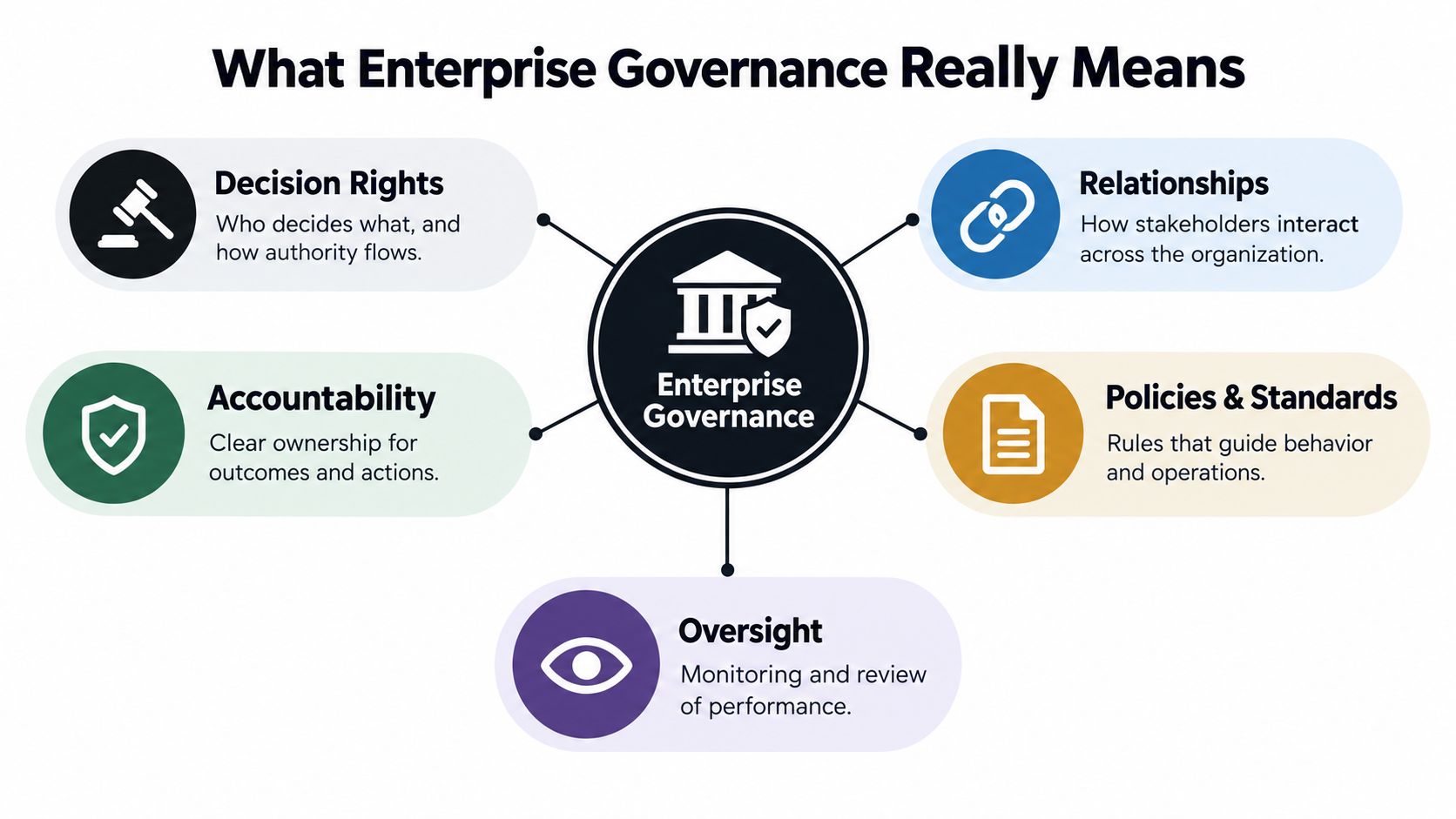
Enterprise governance is the system of relationships, decision rights, accountability mechanisms, and controls that connects management, the board, shareholders, and other stakeholders. In marketing, it answers a practical set of questions: who can launch, who can pause, who can approve an exception, and who has to explain the outcome later (OECD Principles6/en/pdf)).
Like traffic rules, governance pairs authority, supervision, and disclosure so campaigns keep moving without improvising outside policy. Roads create movement, but they do not create order on their own. Governance gives that order to marketing operations, especially when AI is making more of the day-to-day decisions.
The one-sentence test for marketers
A campaign decision is governed only if a reviewer can answer four questions without guessing, who was allowed to act, what rule applied, what evidence was recorded, and who could challenge the decision later. That is the difference between a helpful workflow and a system that can stand up under audit.
The OECD framework organizes governance around shareholder rights, equitable treatment of shareholders, stakeholder roles, disclosure and transparency, and board responsibilities (OECD Principles, board responsibilities section). For a marketing team, those ideas become simple operating habits. Customers are treated consistently, claims are traceable, brand promises are reviewed, and leadership can see what the system is doing before a bad message goes live.
A practical way to read governance is through responsibility, accountability, fairness, and transparency, ideas the World Bank uses as underlying governance concepts. Responsibility means someone owns the task. Accountability means someone answers for the result. Fairness means the same rule applies across similar cases. Transparency means the logic is visible enough to inspect. In a martech stack, those are the difference between controlled scale and mystery.
If a campaign, segment, or offer cannot be traced back to an approved authority, it isn't governed, it's just active.
That matters before AI gets creative. Governance sets the rules first, then lets the machine operate inside them.
Core Principles That Keep Marketing Honest
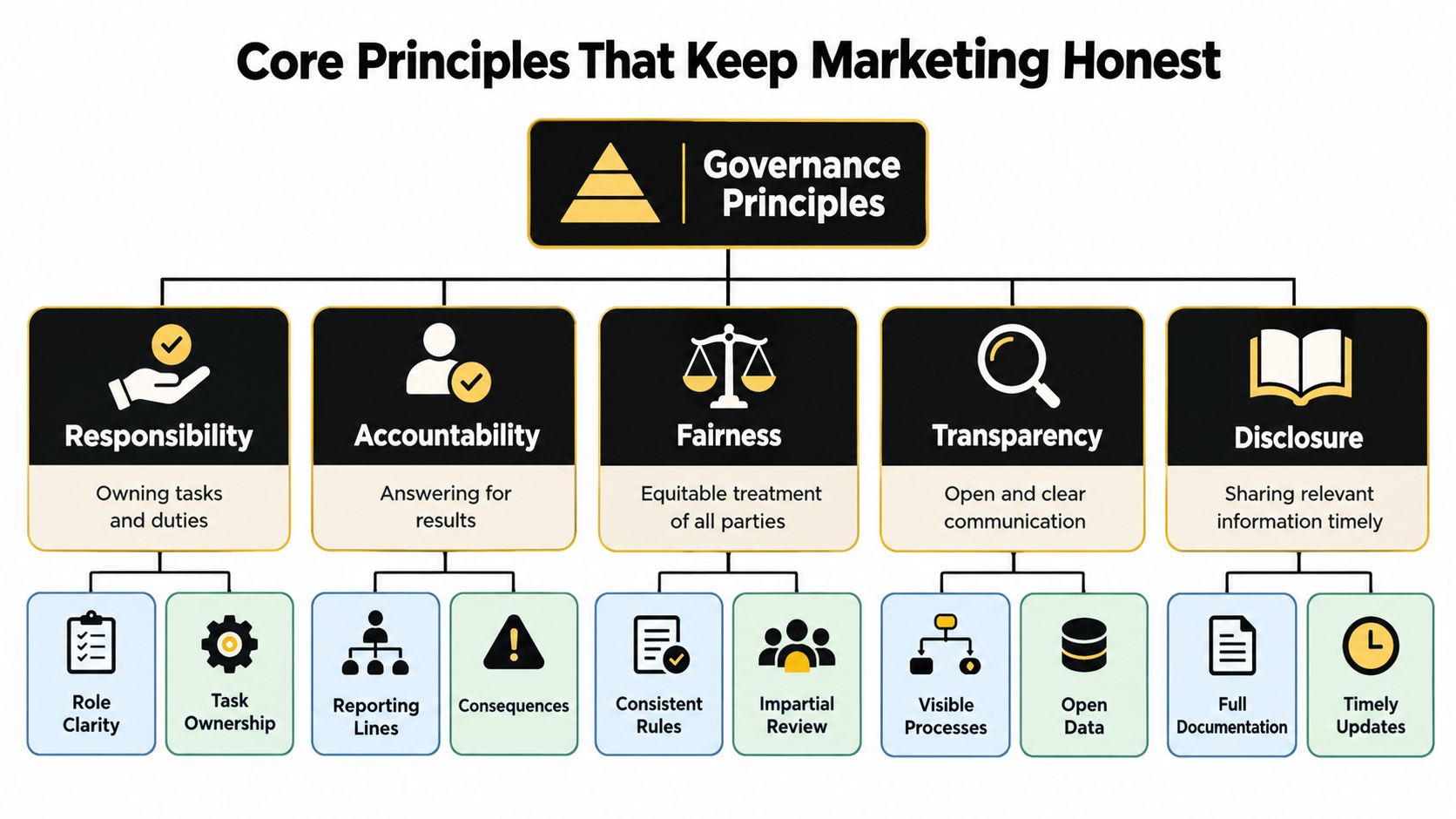
Board language can seem distant until it is translated into campaign language. Responsibility means the lifecycle email owner owns the journey, not just the channel calendar. Accountability means the person who approved a launch can be asked to explain why the segment, claim, or spend decision was reasonable.
Fairness is the rule that keeps one customer from receiving a benefit while another customer with the same status gets excluded for no clear reason. Transparency means the team can see why the system picked an audience, generated a message, or changed a bid. Disclosure is the habit of documenting the basis for claims, partnerships, and data use so the business can show its work later.
Why the principles matter in daily marketing work
A marketer who understands these principles can defend process, not just output. If a promotion is rejected, the reason shouldn't be “because legal said no.” It should be “because the claim, audience, or disclosure didn't meet the rule set that protects the company and the customer.”
That logic also applies when the team works with creators or affiliates. A clear resource on how to disclose paid partnerships is useful because it shows how disclosure turns a vague trust issue into a repeatable publishing standard. The same discipline keeps brand approvals from becoming personal preference contests.
The World Bank's core ideas, responsibility, accountability, fairness, and transparency, also help explain why governance isn't just about control. It is about making the organization understandable to itself. If a marketer can explain why a policy exists, the policy is much more likely to be followed when pressure rises.
A practical way to remember the principles is this: responsibility assigns the work, accountability attaches the outcome, fairness protects consistency, transparency exposes the reasoning, and disclosure makes the record usable. Those are the habits that keep a marketing engine credible when the volume of decisions starts to climb.
Roles Policies and Controls in Plain English
Governance becomes real when someone can say who may do what, under which rule, and with what evidence. ISO 37000 names internal controls, reliable assurance, accountability, transparent decision-making, and responsible use of data as core governance mechanisms (ISO 37000). For marketers, that means an action is not approved just because someone clicked a button, it's approved because the button belonged to an authenticated role operating under a known policy version.
The operating pieces
Roles answer who. Policies answer what is allowed and where the thresholds sit. Controls answer how the rule is enforced. In an AI marketing stack, that often means SSO-backed identity, SAML-based sign-in, approval queues, scoped API keys, brand voice guardrails, and immutable logs that preserve the evidence after the fact.
A policy without an enforcement point is a suggestion.
Many teams get stuck at this stage. They write the standard, yet the send system, content tool, or automation platform still lets people act outside it. The result is a process that looks neat in documentation and loose in practice.
The comparison below makes the difference visible.
| Marketing action | Ungoverned risk | Governed control |
|---|---|---|
| Launching AI-written copy | Brand drift, off-message claims, inconsistent tone | Brand voice policy, review queue, versioned approvals |
| Editing a customer segment | Wrong audience, privacy exposure, hidden bias | Role-based access, consent checks, change logging |
| Increasing campaign spend | Overspend, duplicate buys, no escalation | Threshold-based approval, budget limits, alerting |
| Sending an email | Unsubscribed or suppressed contacts receive it | Send-time suppression enforcement, immutable audit trail |
| Updating a campaign brief | Team confusion, stale instructions, conflicting versions | Policy versioning, timestamped records, assigned owner |
The idea is not to slow the marketer down. It is to make the decision reconstructable. A reviewer should be able to see the authenticated identity, the policy version, the timestamp, the evidence, and the result without depending on someone's memory.
For teams looking to formalize that structure, a marketing governance framework is useful because it turns loose expectations into named owners, approval thresholds, and repeatable checks. Once those controls exist, the team can move faster with less fear, because the boundaries are no longer implied, they're enforced.
How Risk and AI Governance Loops Work
COSO shows how enterprise risk moved from a fraud-response problem to part of strategy and performance. COSO published its first Enterprise Risk Management framework in 2004 and substantially revised it in 2017 under the title Enterprise Risk Management, Integrating with Strategy and Performance (COSO overview). The newer model organizes governance into five parts, governance and culture, strategy and objective-setting, performance, review and revision, and information, communication, and reporting.
Why the loop matters for AI marketing
AI marketing changes too fast for a one-time approval to hold. Models drift, audiences change, promotions rotate, and data quality shifts. NIST frames AI governance around Govern, Map, Measure, and Manage, with governance woven through the full risk lifecycle (NIST AI RMF core). The goal is continuous control, not a ceremonial sign-off.
Mapping shows where a campaign can fail. Measurement turns those risks into signals the team watches. Management applies the response, which may include approval gates, human review, rate limits, access restrictions, or rollback. The loop is complete only when the system learns from what happened and tightens the next decision.
A practical rhythm for AI-assisted campaigns
- Govern sets the policy, the owner, and the escalation path.
- Map identifies which workflows can affect customers, budgets, or regulated claims.
- Measure watches accuracy, resilience, privacy, explainability, and bias-related risk.
- Manage applies the control when the output crosses the threshold.
That rhythm matters because campaigns do not fail only at launch. They fail at 2 a.m. when a model starts generating off-brand copy, or when a spend spike goes unnoticed until the budget is already spent. NIST also calls for documented roles, communication lines, risk-management processes, and organizational accountability, which makes the loop operational instead of theoretical (NIST AI RMF, Govern function).
Record the off-brand output, the threshold crossed, and the tightened prompt rule with version and owner so the next 2 a.m. run is blocked automatically.
Enterprise Governance Examples Inside Marketing Platforms
The easiest way to see governance is inside a live marketing workflow. A campaign manager signs in through SSO, but login does not create broad authority. The role is scoped, permissions stay narrow, and the first thing the system checks is authorization.
A content agent can produce a polished draft and still take the wrong action at the right time. It may reach for an audience that did not consent, a segment that is suppressed, or a brand voice that does not match the approved rules. That is why platforms need controls such as consent-status validation at execution time, suppression-list integrity checks, row-level access controls, model-output sampling, campaign holdouts, anomaly alerts for spend or send volume, and immutable audit logs, per NIST AI RMF controls.
What governed execution looks like
A governed platform ties every action to a person or agent, a permission set, and a record. If an agent tries to overspend, the spend limit stops it. If it tries to email an unsubscribed segment, the suppression layer blocks the send. If a brand manager edits a prompt, the version history shows who changed it and why.
That is the difference between “the system did it” and “the business approved it.” In a mature setup, the approval queue acts like a control tower, not a bottleneck. Higher-risk actions move to the right reviewer, while low-risk tasks pass through quickly because the policy already knows what is allowed.
One concrete failure looks like this. An AI-assisted campaign could raise spend 40% overnight or email a suppressed segment unless spend limits and send-time suppression block it. That is the kind of mistake governance is built to catch before it reaches customers or budget owners.
Here is the operational pattern that keeps the stack readable after the fact:
- Identity is authenticated. The actor is known.
- Authority is scoped. The actor can only touch approved objects.
- The policy version is captured. The rule in force is preserved.
- The action is timestamped. The sequence can be reconstructed.
- Evidence is retained. The audit trail supports review and remediation.
A governed execution platform can matter for teams that need brand rules and execution in the same place. The point is not the content module by itself. It is that policy, approvals, and proof sit next to the work instead of around it.
When the workflow is built this way, marketers can hand off routine tasks with less anxiety. The machine can move quickly, but only inside the lanes the business has already drawn.
Governing AI Marketing Without Slowing Growth
A campaign can move fast and still be governed. The question is whether the team can show who asked for the work, who approved it, and what limits were in place before anything went live. That matters because an IDC-backed finding showed a trust gap, with 58% of consumers believing organizations fail to hold themselves accountable for harmful AI use, compared with only 23% of executives (IDC research).
Enterprise governance gives marketing a set of lanes. Customer-data workflows, spend changes, audience targeting, and support replies do not need the same level of control, so the policy should treat them differently. Some actions can publish after review, some can wait for a timed approval, and some should stay inside strict thresholds until a human checks them.
A short checklist for the next review cycle
- Name the owner. Every campaign, segment, and agent needs one accountable person.
- Set the limits. Budget caps, audience boundaries, and send rules should be visible before launch.
- Require the proof. Consent, approvals, and audit logs should travel with the action.
- Define the override. Human review should be able to stop or revise a high-risk decision.
- Review the brand rules. Teams can use versioned brand voice rules with claim examples and reviewer thresholds.
- Check the holdouts. Measurement should show what the work caused, not just what it touched.
Start with the workflows that touch customer data, money, or external communication. Those are the places where a mistake can create real damage, so they deserve the clearest rules first. As the controls prove reliable, expand them to lower-risk work.
Teams building agentic workflows can also see how AdCrunch uses AI agents for a practical example of structured automation. That kind of setup works best when approvals, identity, and audit trails sit beside the work instead of outside it.
Governance does not slow growth. It lets marketers hand off more work with less hesitation because the business can still trace what happened and why it was allowed. The next step is simple, assign one owner per workflow, then require consent proof and an audit log ID before any send or spend is released.
Share this article