Personalization on Websites: A Practical Marketing Playbook

The AI CMO team
Oct 17, 2026
A marketing director opens the weekly dashboard and sees the same familiar pattern: bounce rates haven't moved, campaign traffic arrives on autopilot, and every visitor lands on the same page. An ecommerce shopper looking for a specific product gets the generic homepage. A B2B prospect already evaluating a solution sees the same introductory message as someone who's never heard of the company.
That mismatch is the problem with personalization on websites. It isn't a shortage of dynamic headlines or clever audience segments. It's that teams often launch changes without answering the harder question first: what business value did personalization create compared with showing the original experience?
McKinsey reported that 71% of consumers expected personalized interactions, while 76% became frustrated when those experiences were absent. The same research found that personalization most commonly produced a 10–15% revenue lift, with company-level results ranging from 5% to 25% depending on execution and industry. Those figures are benchmarks, not guarantees, and they're useful only when a team measures what its changes caused. McKinsey's personalization statistics offer context for the expectation gap, but clicks alone can't show whether a personalized experience earned its place.
Table of Contents
- Why Every Visitor Still Sees the Same Page
- What Website Personalization Actually Means
- The Four Personalization Approaches Side by Side
- Data and Tech a Personalization Program Needs
- An Implementation Roadmap That Avoids the Hype Trap
- Two Playbooks Drawn from Real Marketing Stacks
- Measuring Increment Instead of Counting Clicks
- Privacy, Trust, and the Optimization Loop You Actually Run
Why Every Visitor Still Sees the Same Page
A generic website is easy to publish and difficult to defend. The same hero, navigation, product recommendations, and calls to action serve visitors with different needs, histories, and levels of intent. That may be a sensible starting point, but it becomes a commercial blind spot when the team assumes a page is working because people click it.
The bigger risk is confusing activity with impact. A personalized offer might attract more clicks while shifting purchases that would have happened anyway. A custom product list may increase immediate conversion but narrow discovery. The useful question isn't whether a visitor interacted with the page. It's whether the experience improved the outcome compared with a credible alternative.
Operating principle: Treat every personalization idea as a hypothesis with a counterfactual. The control experience isn't a formality. It's how the team finds out what the change was worth.
That standard changes the conversation between marketing, analytics, and product. Instead of asking which audience needs a custom homepage, the team asks which customer problem merits a different experience, what signal justifies the change, and what result would show incremental value. In ecommerce, the answer might involve helping a shopper find a relevant product without hiding the rest of the catalog. In B2B SaaS, it might mean showing an account-specific route to evaluation without burying the product information a buyer needs.
Teams starting with retail use cases can compare approaches in this guide to ecommerce personalization. The principle applies beyond commerce: personalization earns investment when it makes a relevant task easier and produces business value that holds up against a control, not just when the page looks more customized.
What Website Personalization Actually Means
Personalization is a spectrum, not a button in a content management system. At the cosmetic end, a page inserts a visitor's name or swaps a hero image. Further along, the experience uses observed behavior to shape recommendations. At the advanced end, it predicts likely needs or adapts the journey for a known account.
Consider the difference between a grocery shelf and a personal shopper. The shelf presents the same selection to everyone. A shopper who remembers what a customer bought last month can make a useful suggestion, but only if that memory helps the customer choose. The website equivalent isn't merely greeting someone by name. It's using a relevant signal to decide what to show, while preserving access to alternatives.
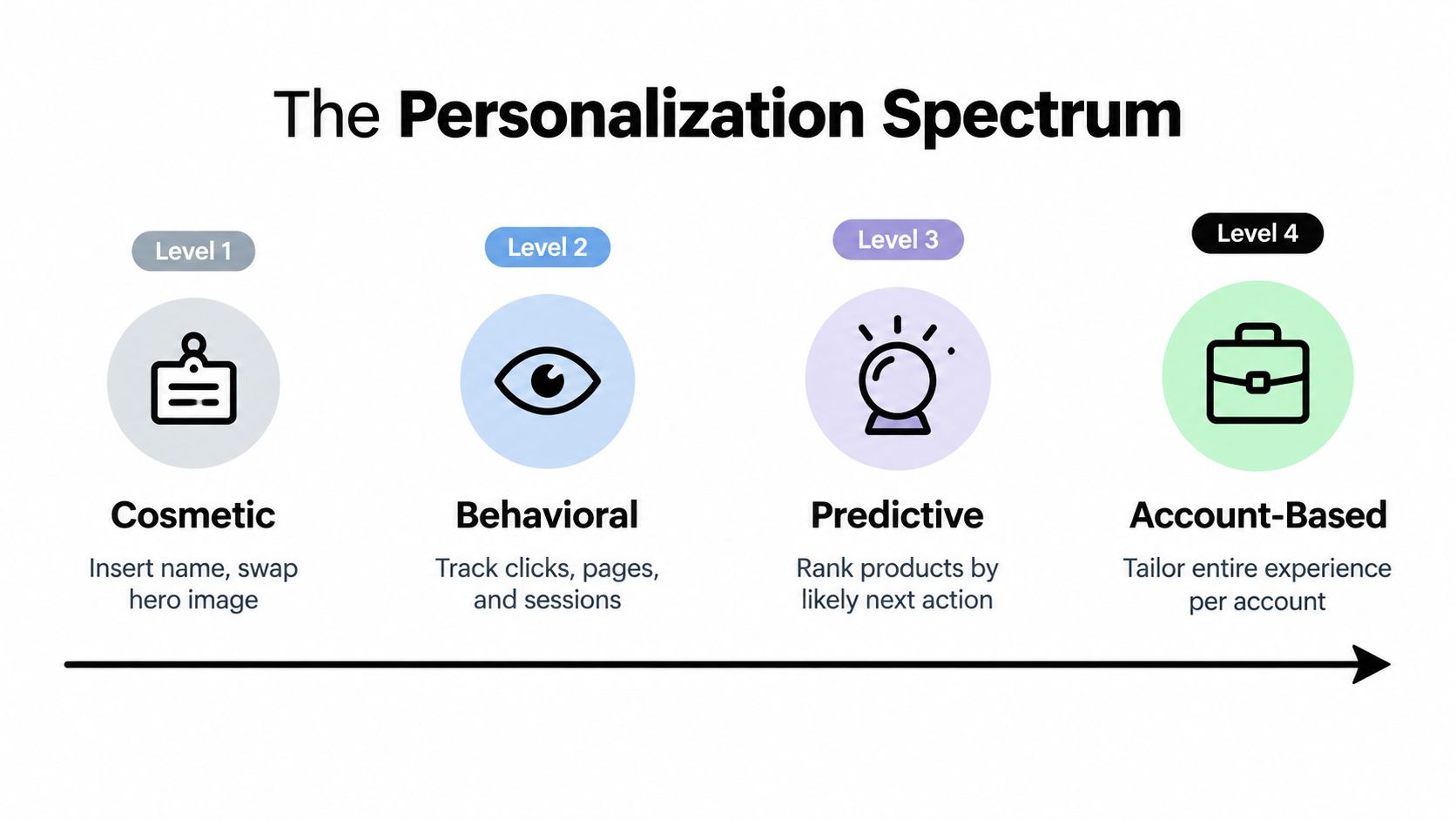
Four operating modes
Behavioral personalization responds to actions such as viewing a category, returning to a page, or abandoning a journey. It can support discovery by surfacing related content or products, provided the signals are reliable and the change doesn't trap visitors in a narrow path.
Contextual personalization uses the situation around the visit, such as the page someone arrived on or the product they're currently considering. It's useful when there's little identity data but the immediate task is clear.
Predictive personalization ranks content or offers according to an estimate of what a visitor may need next. It can help with consideration or activation, but a score is a prediction, not evidence that the treatment will cause a better outcome.
Account-based personalization adapts the experience for a known organization, often using account fit, buying stage, or product relationship to make the next step more relevant. A team might adjust proof points or calls to action, while ensuring the page still answers the buyer's core questions.
These modes can be combined, but complexity isn't a measure of quality. A practical overview of personalization in marketing strategies can help teams connect on-site decisions to the wider marketing journey. The operating test stays simple: identify the signal, explain why it matters, and measure whether acting on it beats the experience visitors would otherwise receive.
The Four Personalization Approaches Side by Side
The right approach depends less on ambition than on the evidence the team can use. A predictive model can't rescue incomplete event tracking, and account-based content won't be reliable if the website can't recognize an account with appropriate consent. Cold-start tolerance matters because many visits arrive with little or no dependable identity history.
| Approach | Primary signal | Decision speed | Best for | Cold-start tolerance |
|---|---|---|---|---|
| Behavioral | Clicks, viewed pages, and session activity | Fast when session events are available | Recommending related content or responding to recent browsing | Moderate, because the current session can provide signals |
| Contextual | Landing page, page content, or visit context | Immediate | Matching the experience to the task visible in the current visit | High, since a useful decision can rely on page context |
| Predictive | Model scores based on available customer and behavioral data | Depends on scoring and activation setup | Ranking products, content, or next actions when the model has usable inputs | Low when a visitor has little history |
| Account-based | Account identity, fit, buying stage, and relationship | Fast once identity and account data are available | Coordinating B2B proof points, evaluation paths, or customer journeys | Low for anonymous traffic, higher for recognized accounts |
The table describes trade-offs, not a universal ranking. Contextual treatments are often a practical starting point when the visitor is anonymous but the page makes the task clear. Behavioral rules become more useful as session activity builds. Predictive ranking needs trustworthy inputs and a way to test whether its recommendations add value. Account-based experiences are strongest when the team can connect account context to a real buying need, not just a company name.
Segmentation should support a decision, not become a taxonomy project. A team can use customer segmentation strategy to clarify which groups need distinct treatment, then choose the simplest approach that can test the underlying hypothesis. If two segments receive the same experience and produce the same outcome, maintaining separate rules adds operational work without proving business value.
Cold-start handling deserves explicit design. When a visitor has no usable history, the site can keep the standard experience or rely on immediate context instead of pretending to know more than it does. That fallback is a feature: it protects the visitor from a weak guess and gives the team a clean comparison for later experiments.
Data and Tech a Personalization Program Needs
A personalization stack is only as dependable as the data path behind the decision. Before buying another decisioning tool, marketing and engineering should agree on how a visitor is identified, what consent allows, which events are captured, and how a changed experience reaches the page.
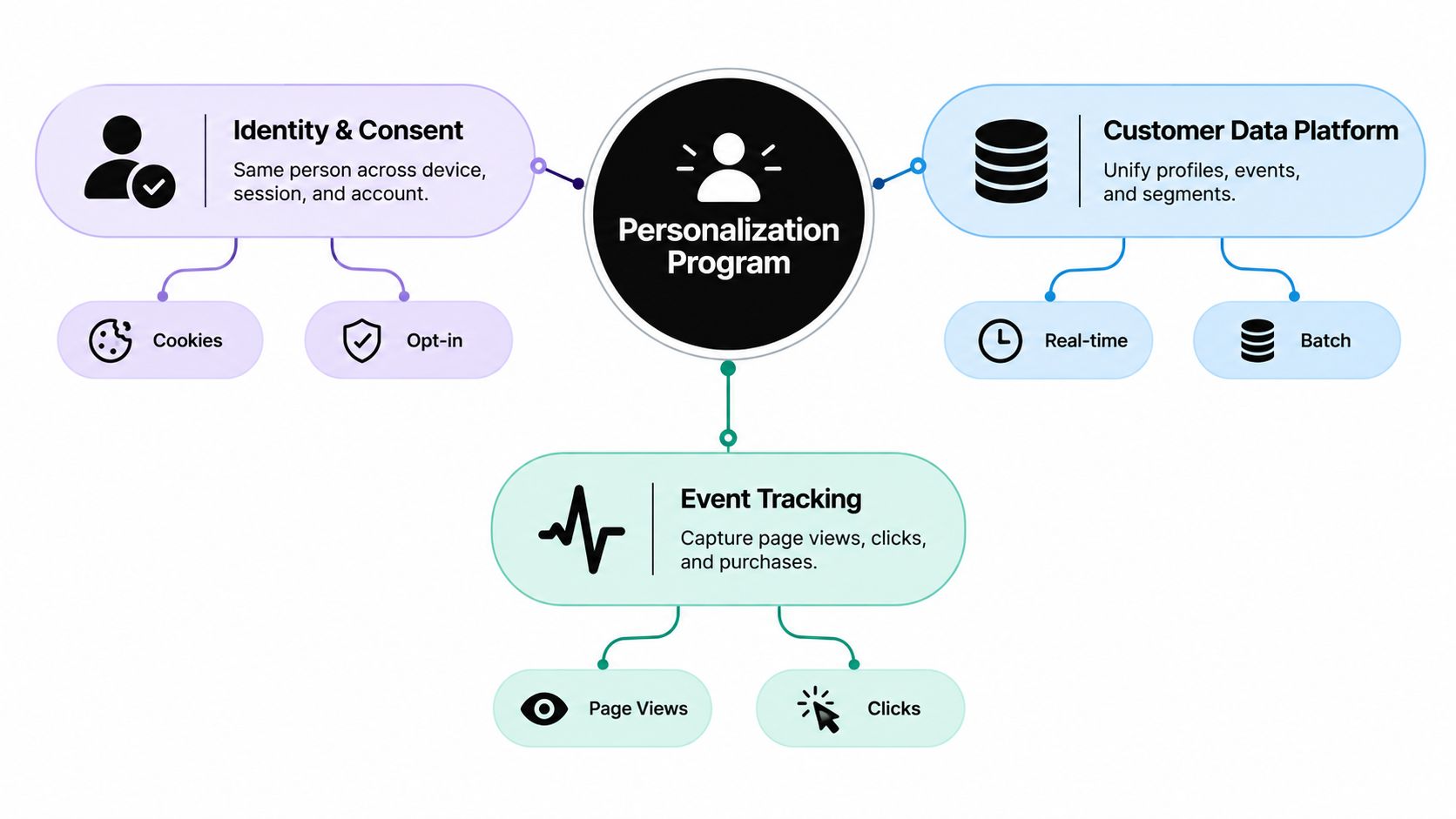
The operating layers
Identity and consent establish which data can be tied to a person, session, device, or account, and under what permissions. The accountable outcome is a usable identity decision with consent respected, not a larger profile at any cost.
The customer data platform or warehouse brings customer profiles, events, and segments into a place where marketing and analytics can work from consistent definitions. A first-party data strategy helps clarify what the business should collect and how those signals support customer value rather than just expanding tracking.
Event collection and streaming capture actions such as page views, clicks, purchases, and product use. Real-time events can support an immediate on-site response; batch data can inform slower decisions such as audience planning or model development. The team should be able to explain which events feed each rule and how missing or duplicated events are handled.
Decisioning and models turn approved signals into an experience choice. That may be a straightforward rule, a ranking model, or a prediction of intent. The accountable outcome is a decision the team can test and explain, not an opaque score with no clear action attached.
Delivery puts the chosen content on the site or across channels. A site SDK, server-side rendering, email, and push each bring different latency and coordination requirements. Engineering should set performance limits so personalization doesn't slow the page or delay the task the visitor came to complete.
Tools don't fix weak foundations. If identity resolution merges different people, consent rules are unclear, or event definitions vary across teams, the model makes inconsistent decisions faster. The practical shopping list is therefore a reliable data source, clear permissions, tested instrumentation, understandable decision logic, and a delivery path that can be monitored.
An Implementation Roadmap That Avoids the Hype Trap
A team deciding whether to personalize a page should first ask what the change is worth compared with leaving the page alone. That counterfactual shapes the roadmap: make signals trustworthy, test whether a treatment adds value, then automate only decisions that have earned it. Personalizing more pages is not progress if the team cannot show an incremental result.
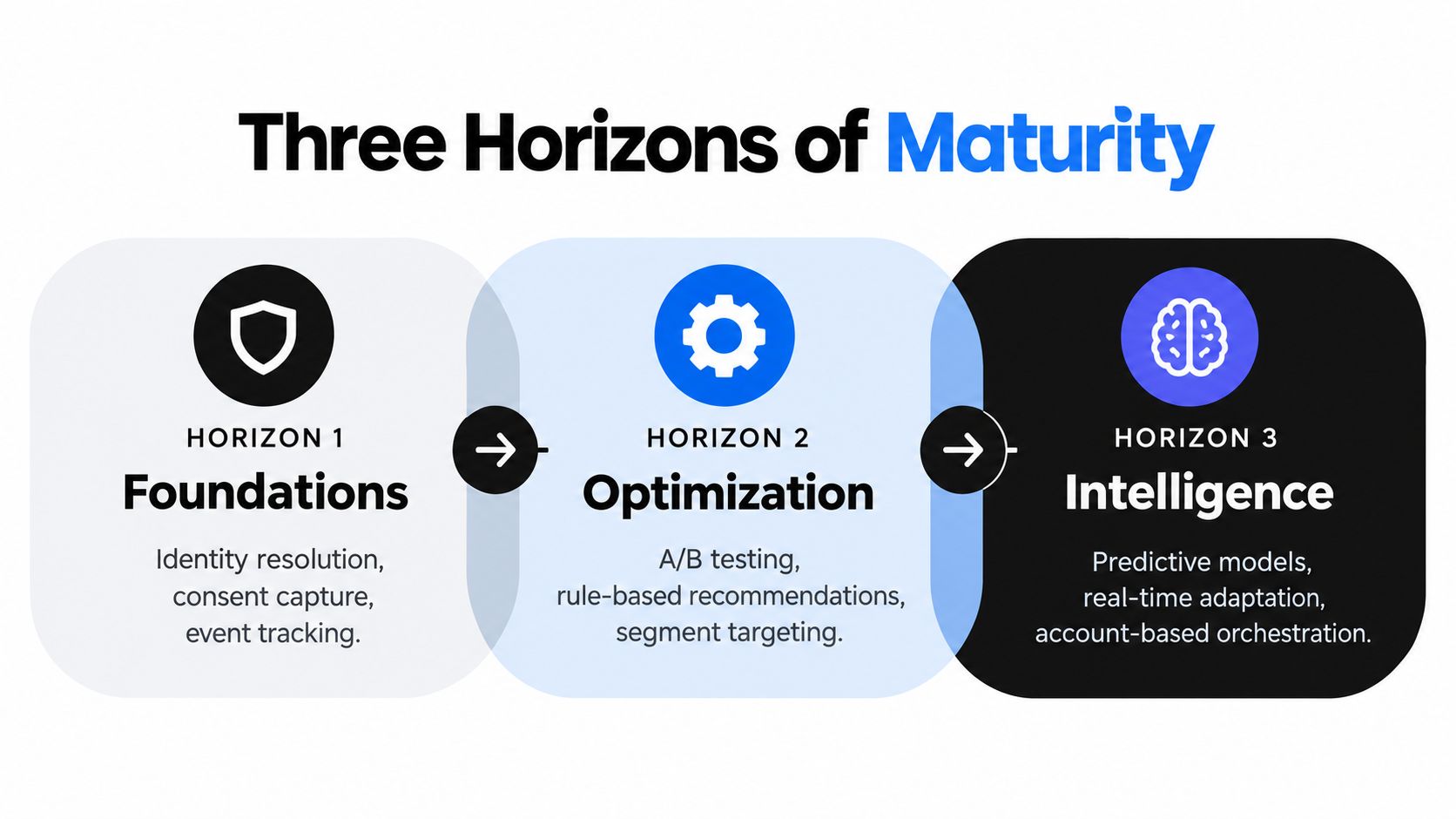
Foundations before automation
Start with identity resolution, consent capture, and event instrumentation. Marketing can test a small number of behavioral segments in existing journeys, such as visitors who viewed a product category or prospects who returned to an evaluation page. Confirm that each segment represents the intended audience, and make the experience change visible and reversible.
Then establish whether the treatment beats doing nothing. Use a holdout or A/B test, and judge a predictive model by the incremental outcome of the decision it drives, not its ability to identify people already likely to buy. Review results quarterly, separating experiences with demonstrated value from ideas that have not earned broader rollout.
Intelligence with boundaries
AI-driven decisioning becomes useful after the data and experiment design can support it. For example, a team could test refreshing on-site segments every ten minutes and changing a journey when a customer's lifecycle stage changes. First validate the event definitions, set rules for what the workflow may change, and keep a holdout so faster decisions do not become unmeasured decisions.
The three-horizon model shown above separates the work: foundations make data usable, optimization tests whether treatments add value, and intelligence scales decisions that have shown promise. The diagram's progression is a sequence of evidence, not a mandate to automate every experience.
The following video offers a related look at how teams can structure the work:
At each quarterly review, set the scope and evidence required to advance. If the team cannot trust an event or explain a treatment, invest in the foundation. If a controlled experiment shows no incremental value, revise or retire the experience before scaling it with AI. The counterfactual stays central: automation earns its place only when the resulting experience performs better than leaving the page unchanged.
Two Playbooks Drawn from Real Marketing Stacks
The same data and decisioning stack can produce different experiences because the customer task differs. An ecommerce team wants to help a shopper find a product or offer worth considering. A B2B SaaS team wants to help an account move through evaluation or get value from a product. Neither needs to personalize the whole website by default.
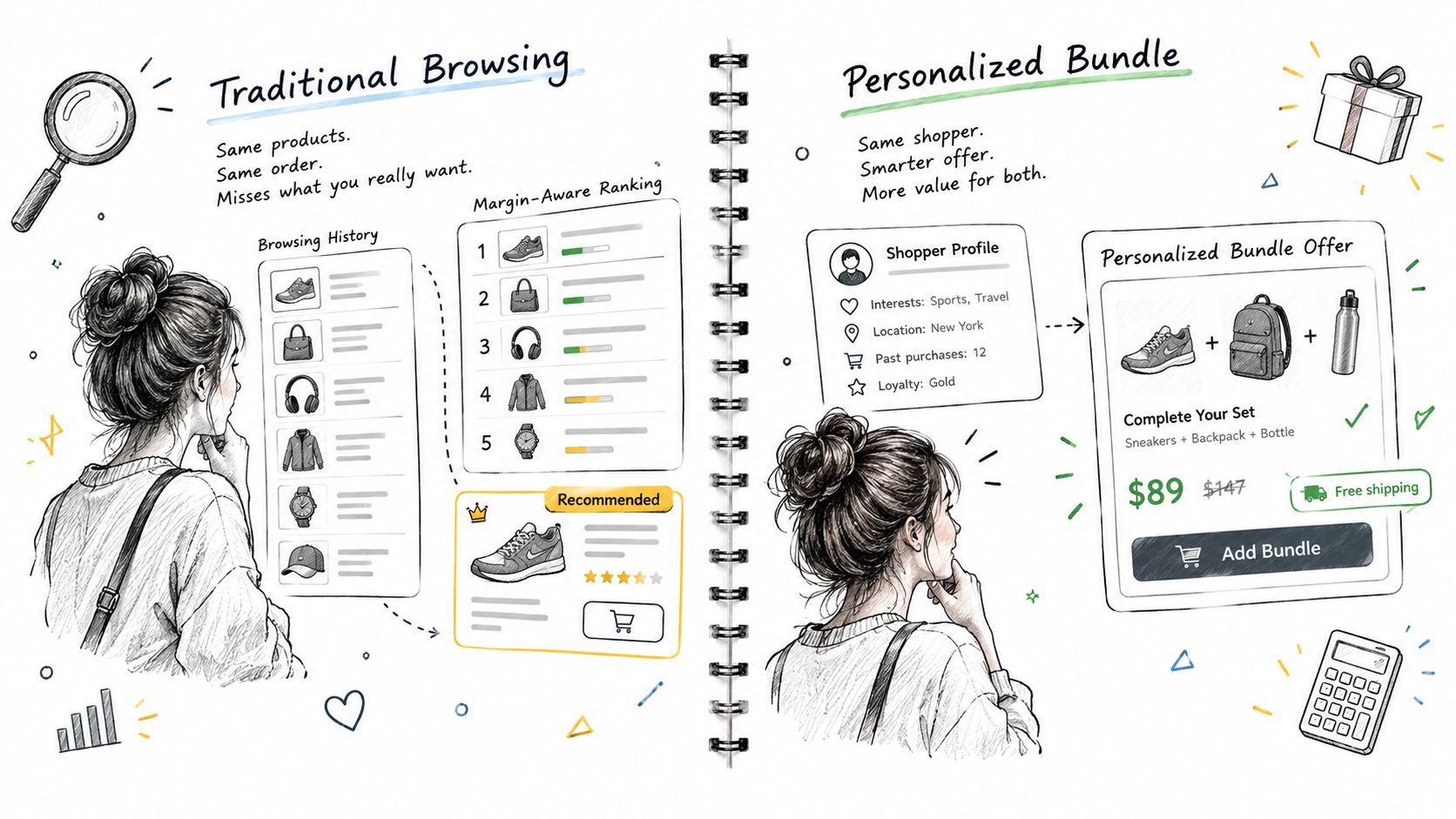
Ecommerce and B2B SaaS
Ecommerce playbook: A shopper's recent browsing history can trigger a relevant hero offer, while margin-aware ranking helps select which products to feature. Lifecycle stage can shape the offer: a first-time visitor may need help discovering a category, while a known customer may respond better to a replenishment or related-product path. The signal is recent browsing or purchase history. Ecommerce marketing owns the offer hypothesis, merchandising checks product relevance and margin, and analytics establishes the holdout. The first metric to watch is incremental revenue or profit per visitor, with discovery and abandonment checked as guardrails.
B2B SaaS playbook: Firmographic context, account intent, and product usage can inform different on-site decisions. A high-value account exploring pricing might see more relevant proof points and a CTA suited to its evaluation stage. An existing user reaching an onboarding page might see a product path that reflects the features they haven't adopted. The signal is account fit or a product-use event. Growth or product marketing owns the experiment, with sales and product teams checking that the experience is accurate and useful. The first metric should match the task, such as qualified progression for an evaluation journey or successful activation for an onboarding treatment.
These examples are operating patterns, not claims about particular companies or guaranteed outcomes. Each treatment needs an owner, a clear signal, an appropriate control, and a metric tied to the task. Teams can also use modular content to test a headline, proof point, or CTA without rebuilding an entire page. That keeps the experiment easier to interpret and makes it less likely that a broad redesign gets credited for a result caused by one useful change.
Measuring Increment Instead of Counting Clicks
A conversion prediction answers, “Who is likely to convert?” An uplift model asks a different question: “Who is more likely to convert because they received this treatment?” That distinction is central to measuring personalization. Someone with strong purchase intent may buy without a personalized offer, so targeting that person can make a campaign look successful without causing an additional sale.
A systematic e-commerce benchmark evaluated three experiments combining uplift-modeling strategies with different machine-learning algorithms, measuring both predictive performance and business value. Its practical lesson is to evaluate incremental outcomes, not just the ability to predict response. Teams can run that logic on site by assigning eligible traffic to a treatment and a control, then comparing outcomes that matter, such as incremental conversion or revenue.
A strong score can identify likely buyers. Only a well-designed comparison can show whether the experience changed what they did.
Build the counterfactual into the journey
Journey holdouts make the comparison operational. In a journey platform, the team can reserve a control group that receives the standard experience while the treatment group sees the personalized content. Results should be read by cohort and segment, with confidence intervals and treatment heterogeneity in view. If the overall average hides groups that benefit and groups that are unaffected or harmed, the team needs to understand that pattern before widening the rollout.
The benchmark also points to a practical targeting rule: prioritize users or segments with positive expected lift, rather than those who are merely likely to respond. A treatment with no credible incremental conversion or revenue should be revised or retired, even if it generates attractive click-through numbers. A treatment that improves one group's outcome but worsens another's needs a narrower policy and further review.
That discipline should include exploration, not just immediate sales. Research found that content personalization improved stickiness and willingness to pay through preference fit and enjoyment, while combined content and design personalization could be ineffective or counterproductive for some outcomes. Earlier research also found that personalized recommendations led users to sample fewer items overall. The team should therefore consider whether a change helps visitors discover the right choice or pushes them toward a narrow path.
Marketing teams building a measurement practice can use marketing ROI measurement as a companion to journey-level holdouts. The core rule remains: count clicks to diagnose behavior, but use a credible counterfactual to decide whether personalization created value.
Privacy, Trust, and the Optimization Loop You Actually Run
Trust is part of the experience, not a legal footnote. A 2026 survey of 11,000 consumers across seven major markets found that 71% considered AI-driven personalization intrusive. The same study found that privacy-aware consumers were nearly three times more comfortable with personalization than privacy-unaware consumers, 53% versus 19% (Usercentrics State of Digital Trust 2026 report). Those findings make transparency and control central to the design, not optional cleanup after a campaign launches.
When a visitor declines tracking, the website still has a job to do. It can use page context or information the visitor deliberately provides, keep the standard experience available, and avoid implying that it knows a person through hidden profiling. If a personalized module changes the page, the visitor should have a clear way to understand or control that experience, including a practical option to reset or opt out.
Close the learning loop
Consent, opt-in behavior, conversion, and retention should be read together. A treatment that earns short-term engagement but undermines trust may have a poor long-term trade-off. Nielsen Norman Group's research on web customization also offers a design warning: people can struggle when they must configure pages or products, and users often prefer completing their task to adjusting settings (Nielsen Norman Group research on customization features). Personalization should reduce effort, not turn the visitor into the operator of the site.
The operating loop is practical: launch a treatment, hold out a control, read the uplift, feed trustworthy results into the next decision, and retire changes that don't earn their place. Document the decision, send, and outcome in an append-only Record so the team can understand what ran, under which policy, and what it learned. The record shouldn't be treated as a substitute for good measurement. It makes measurement and governance easier to audit.
The payoff isn't personalization everywhere. It's a site that responds where the evidence supports a change, stays useful when a visitor declines tracking, and preserves enough choice for people to complete their task. That is how consent and transparency become operating strengths rather than obstacles to marketing performance.
The AI CMO combines a customer data platform, behavior-triggered journeys, holdout groups, and on-site personalization, with approvals and an append-only Record for decisions and sends. Marketing teams can visit The AI CMO to see how those capabilities support a personalization program measured against incremental value.
Share this article