
A messaging framework template shouldn't be a polished PDF that gets approved once and forgotten. That popular advice treats messaging as a branding deliverable, when modern B2B SaaS teams need something closer to a governed operating specification. The framework must guide human marketers, sales teams, automation, and generative AI while remaining connected to customer evidence and revenue outcomes.
The distinction matters because content production now scales faster than review processes. A single positioning decision can appear in landing pages, sales decks, nurture emails, paid campaigns, product prompts, and AI-generated variants. Without ownership, proof requirements, and version control, every new asset creates another opportunity for message drift.
A useful template preserves the strategic elements that should remain recognizable, such as positioning, promise, tone, and reasons to believe. It still gives campaign teams room to adapt the expression for the audience, channel, and buying moment. The result isn't identical wording everywhere. It's a controlled system that makes every execution feel related without making every execution sound the same.
Table of Contents
- Why Static Messaging Documents Fail Modern Teams
- Building the Core B2B SaaS Messaging Architecture
- Adapting Core Pillars Across Marketing Channels
- Governing AI-Generated Content and Message Drift
- Validating Positioning with First-Party Revenue Data
- Embedding the Framework into Your Marketing OS
Why Static Messaging Documents Fail Modern Teams
The assumption that consistency means repeating the same sentence is one of the most damaging ideas in B2B messaging. Consistency should preserve the strategic meaning behind a claim, not force every salesperson, email, and advertisement to use identical copy.
A longitudinal study of advertising and word-of-mouth data found that advertising performs more effectively when it is both distinctive from competitors' previous advertising and consistent with the same brand's prior communications. The study, published in 2021, defines consistency as alignment with expectations formed through earlier brand experiences, while uniqueness helps a message stand out in a crowded market. The published advertising study supports a practical rule for SaaS teams: keep the strategic anchor stable, but allow creative variation around it.
A static document fails because it stores decisions without governing how people use them. Product marketing may update the positioning in a launch brief, demand generation may retain an older promise in paid search, and sales may explain the product through a different category altogether. The document remains technically correct, yet the operating system around it produces contradictory experiences.
The document-to-system shift
A living messaging framework should answer operational questions that a brand guide usually ignores:
- Who owns the claim? Every core statement needs an accountable owner who can approve revisions and resolve disagreements.
- What proves the claim? The template should connect the statement to customer interviews, product evidence, a dataset, win-loss analysis, or another approved source.
- Where can the claim appear? A promise appropriate for a late-stage sales conversation may be too strong for an awareness advertisement.
- When does the evidence expire? Pricing, product capabilities, competitors, and buyer expectations change. Proof needs a last-validated date.
- How will adoption be checked? Teams need audits of real emails, advertisements, landing pages, sales calls, and AI outputs, not just a review of the framework itself.
Communication consistency can also be treated as an analyzable property rather than a subjective brand preference. Research published in 2022 reported mean consistency values ranging from 0.84 to 0.96 across the brands examined and concluded that consistency and commonality in advertising content had a major effect on brand sales, particularly over the long term. The study of consistency, commonality, and sales impact reinforces why a framework should be monitored across campaigns and time.
Practical rule: A framework should control the meaning, evidence, and permitted interpretation of a message. It shouldn't control every word.
Why AI makes drift more visible
Generative AI doesn't create the underlying alignment problem. It exposes and accelerates it. When an AI content system receives incomplete positioning, it fills the gaps with plausible language. That language may sound polished while changing the target buyer, overstating a benefit, or turning a feature into an unsupported business outcome.
Distributed teams face the same issue without AI. Agencies, regional marketers, product teams, and sales representatives all create useful variations. The risk appears when those variations no longer share a recognizable promise or evidence standard.
A modern messaging framework template therefore needs a canonical claim library, audience-specific variants, proof sources, prohibited interpretations, approval status, and refresh dates. That structure lets teams move quickly without pretending that speed removes the need for judgment.
Building the Core B2B SaaS Messaging Architecture
A strong architecture starts with the buyer's situation, not the product catalogue. Consider a B2B SaaS platform that helps revenue teams connect campaign activity with qualified pipeline. Its framework shouldn't begin with dashboards, automation, or integrations. It should begin with the priority buyer, the demand state, and the commercial problem that creates urgency.
Start with the buyer and demand state
The first fields should define:
- Priority buyer: Identify the person who feels the problem, influences the decision, and can explain its commercial cost. A demand generation director may care about qualified pipeline and campaign learning, while a revenue operations leader may care about data reliability and handoff quality.
- Buying situation: Separate active evaluation from problem recognition, replacement, expansion, and urgent remediation. The same buyer needs different proof at each stage.
- Desired outcome: Describe the change in the buyer's work or business, not the feature being purchased.
- Pains and constraints: Capture operational friction, internal objections, budget concerns, implementation risk, and competing alternatives.
- Proof requirements: Record what the buyer needs to believe the promise. Evidence might include product demonstrations, customer language, security documentation, first-party performance data, or a clear implementation model.
A value proposition then connects the audience's problem to a differentiated outcome. For the example platform, “campaign management” is too broad. A sharper proposition might state that revenue teams can plan, launch, and evaluate campaigns against their own customer and pipeline data from one operating layer. The wording is only useful if the business can prove the data connection, workflow, and measurement experience.
Organize the narrative into pillars
Most B2B SaaS frameworks work better with 3 to 5 supporting pillars than with a long list of benefits. The pillar count is a practical guardrail, not a reason to compress every proof point into a slogan.
A useful set for the example could include:
- Unified customer and revenue data: Explain which records connect, who can use them, and how the system keeps reporting consistent.
- Operational speed: Show how teams move from brief to execution without rebuilding the same campaign logic across disconnected tools.
- Full-funnel accountability: Connect campaign activity to qualified opportunities, sales progression, retention, or another commercially meaningful outcome.
- Controlled automation: Clarify what AI can produce or execute, what requires approval, and which rules cannot be bypassed.
Each pillar needs a problem statement, differentiated outcome, evidence, objection response, next action, and permitted interpretation. “Improves efficiency” isn't proof. A usable entry might specify the workflow affected, the evidence available, and the buyer group allowed to make the claim.
Teams that need a more complete identity layer can use this brand identity template for strategic foundations, while sales leaders can pair the framework with a practical sales team operating problem fix that turns approved positioning into usable field content.
Add voice rules that AI can follow
Voice guidance should describe observable choices rather than adjectives such as “creative” or “friendly.” The template can specify sentence length, technical depth, preferred verbs, banned claims, audience vocabulary, and the difference between confident language and unsupported certainty.
For example, the SaaS brand might use direct language, name the operational consequence before the feature, explain technical concepts in plain terms, and avoid claiming that automation is autonomous unless the product performs without approval. Human writers and AI tools can then produce different assets while working from the same boundaries.
The completed architecture should be small enough for a campaign manager to use and precise enough for a sales enablement owner to audit. If a pillar can't be connected to an audience problem and credible proof, it belongs in a backlog, not in the canonical message library.
Adapting Core Pillars Across Marketing Channels
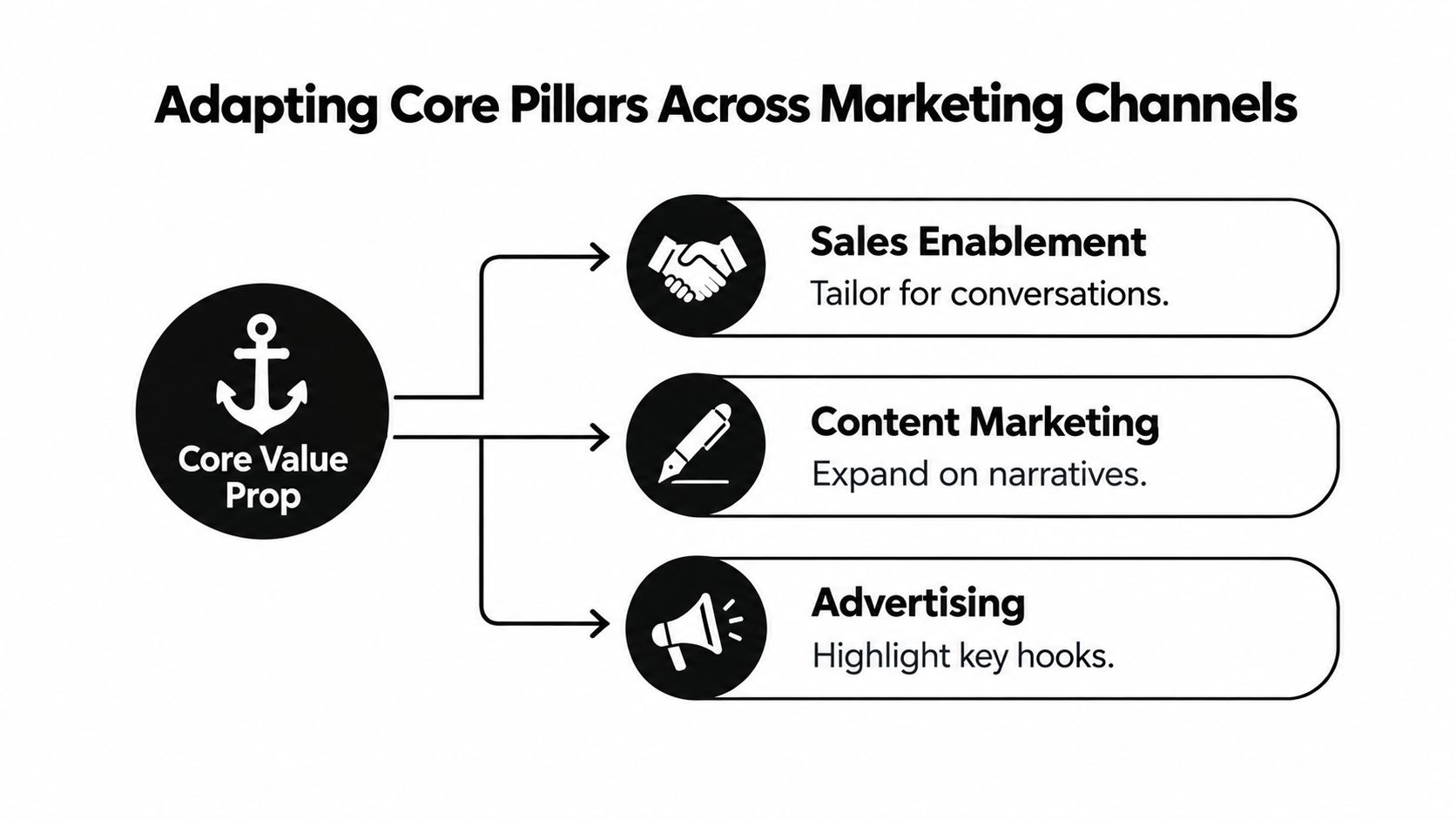
A core pillar earns its place when it survives translation across channels without losing its commercial meaning. A landing page can explain the problem and support the claim with evidence. A sales deck can turn the same pillar into discovery questions and objection responses. An advertisement must often reduce it to a distinctive hook.
That doesn't mean every channel gets a shortened version of the same paragraph. Each execution should specify the buyer stage, claim, evidence, call to action, and permitted depth.
Use the channel as a constraint
A high-intent landing page can lead with the buyer's problem, establish the differentiated outcome, and then present proof close to the conversion action. The page might use the unified-data pillar to explain why disconnected reporting creates uncertainty, followed by a product demonstration or customer evidence.
A sales deck needs a different sequence. The seller may use the same pillar to diagnose reporting gaps, ask how campaign and CRM records are reconciled, and respond to an objection about implementation. The claim becomes a conversation tool rather than a headline.
Lifecycle email can make the message more situational. A new customer might receive education about connecting data sources, while an active user receives a prompt tied to an unfinished workflow. Paid social and search need greater compression. They should emphasize one recognizable problem or outcome, not attempt to carry every pillar at once.
A channel adaptation is successful when the buyer recognizes the same promise without receiving the same asset.
Create a variant record for every execution
A useful template adds a small record beneath each pillar:
| Field | Example use |
|---|---|
| Audience and stage | Demand generation director, active evaluation |
| Core claim | Campaign performance can be evaluated against qualified pipeline |
| Evidence | Approved product workflow or first-party customer evidence |
| Channel expression | Landing-page headline, sales discovery prompt, retargeting hook |
| Call to action | Compare measurement workflow, request a demonstration, or start an assessment |
| Restrictions | No unsupported revenue guarantee or implication of automatic attribution |
This structure gives AI studios and human copywriters room to create variants while retaining semantic alignment. It also gives reviewers something concrete to check. A reviewer can ask whether the asset changed the audience, outcome, proof level, or implied guarantee, rather than relying on a vague sense that the copy “sounds off.”
Personalize without fragmenting the promise
Personalization should change relevance, not rewrite the brand's strategic position for every segment. A security buyer may need governance and access language. A growth leader may need faster testing and pipeline visibility. Both can receive segment-specific proof while the central value claim remains intact.
This operating model becomes more important as personalization expands. McKinsey reports that Michaels increased the share of personalized email campaigns from 20% to 95%, a change associated with a 40% lift in response rates and a 25% reduction in deployment costs. The report on generative AI and consumer marketing connects that outcome to repeatable segmentation, content adaptation, delivery, and measurement rather than generic personalization language.
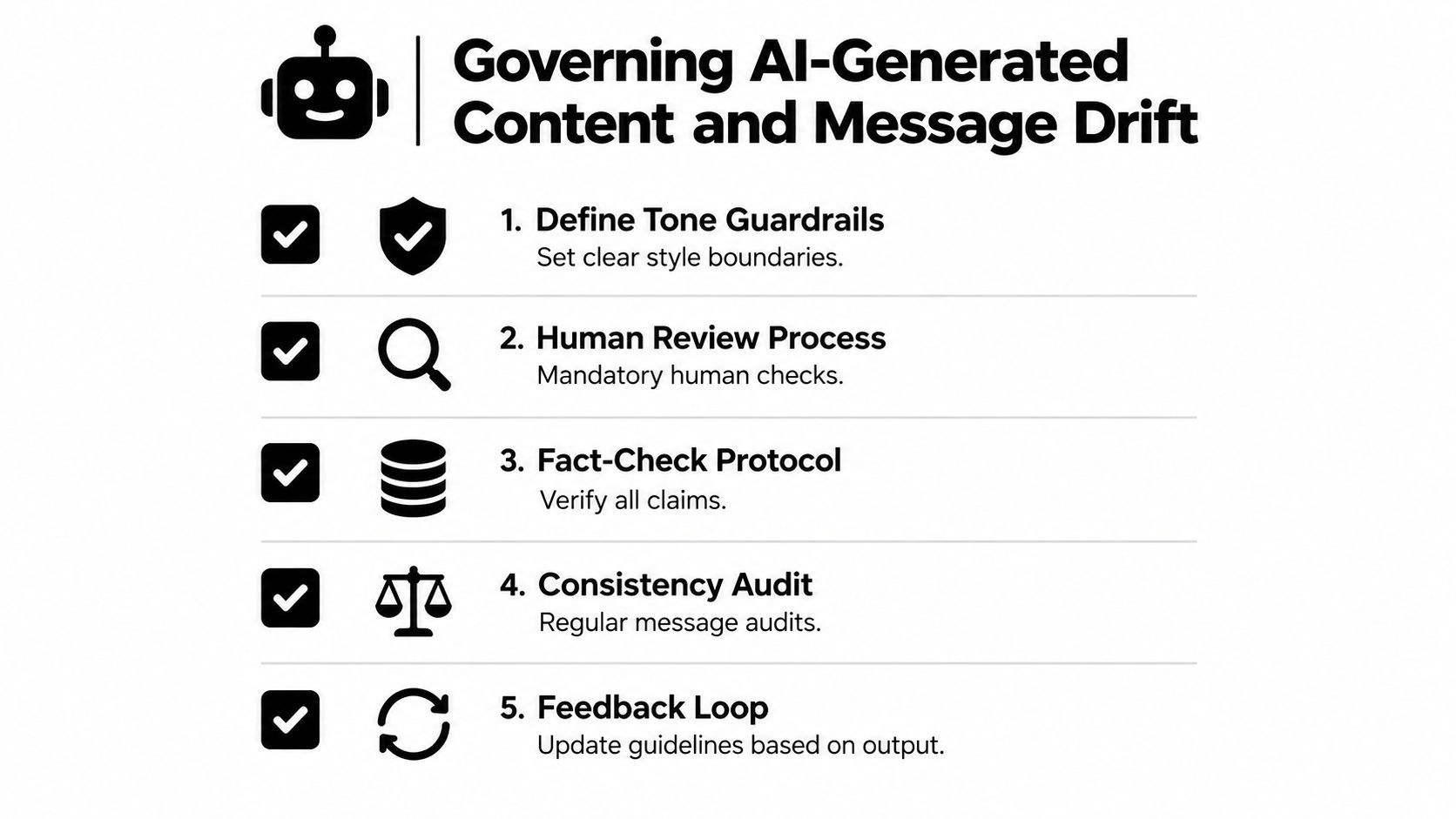
AI-generated variants need the same discipline. Tone guardrails, human review, fact checking, consistency audits, and feedback loops should appear in the workflow, not only in a brand handbook.
A practical walkthrough of channel adaptation and AI-assisted production can also help teams standardize execution:
Governing AI-Generated Content and Message Drift
A messaging framework earns its place in the marketing stack when every claim has a source, owner, approval status, and review condition. Without those controls, AI can multiply weak or outdated language across campaigns, sales materials, and customer-facing experiences.
Build the operating specification around a canonical message matrix. Each row should connect a segment and buying stage to an approved problem statement, differentiated outcome, proof point, objection response, next action, and usage restrictions. Distribute that matrix through campaign briefs, content templates, sales decks, CRM fields, and prompts used by AI specialists. The document becomes useful only when the systems producing and approving content use the same current version.
Attach evidence to every claim
A claim record needs more than the sentence:
- Evidence source: Link to a transcript, dataset, product record, customer outcome, or approved document.
- Confidence level: Separate validated evidence from a working hypothesis.
- Owner: Name the person accountable for interpretation and updates.
- Approval status: Show whether legal, product, sales, or marketing review is required.
- Last validation date: Make stale proof visible.
- Expiration condition: Define the change that would invalidate the claim, such as a product release, pricing change, competitor move, or altered customer segment.
- Permitted interpretation: State what the claim supports and what it does not support.
Record the test hypothesis alongside the claim. A team might test whether framing around qualified pipeline earns more sales acceptance than framing around reporting efficiency. That record keeps a successful headline from becoming an unexamined promise. It also gives AI tools a clear boundary between approved positioning and language still under review.
A broader marketing governance framework can connect these message controls to campaign ownership, approval paths, and operational accountability.
Audit outputs, not just documents
Review the assets buyers encounter. Sample advertisements, landing pages, nurture emails, sales conversations, and AI-generated content for semantic alignment, prohibited claims, evidence usage, and outdated product language. Compare approved language with published output, then log the issue, responsible owner, correction, and recurrence risk.
Benchmark research reports that only 23% of B2B organizations achieve messaging consistency above 75% across sales, marketing, and product teams, while documented frameworks are associated with 31% higher win rates on deals above $100,000. The messaging framework benchmark research also reports that 65% of marketing-produced sales content goes unused by sellers. These findings point to separate operating failures. Some frameworks never reach daily workflows. Other content is produced without enough buyer validation or field relevance.
Assign one accountable owner, maintain version control, record evidence expiration dates, and run quarterly adoption audits. Trigger a review after significant product, pricing, market, or competitor changes. Track whether teams use the current matrix, whether AI outputs pass review, and whether sales can find approved proof without creating a parallel version.
Governance standard: If an AI system cannot identify the source, owner, approval status, and age of a claim, it should not publish that claim automatically.
Validating Positioning with First-Party Revenue Data
A messaging committee can approve a phrase because it sounds differentiated, while buyers ignore it in the first sales conversation. Validation requires controlled exposure, first-party evidence, and a measurement plan that follows the buyer beyond the click. Treat the framework as a living operating specification: each claim should carry an owner, evidence source, approval status, and a review path.
Start with a testable hypothesis. A B2B SaaS team might compare two problem framings on a landing page, test alternative proof language in email, or give sales representatives different positioning across matched cohorts. Keep the audience, offer, destination, and buying stage consistent wherever possible. Otherwise, a conversion change may reflect the offer or audience rather than the message.
Measure the full funnel
Clicks and engagement show whether an idea earns attention. Revenue data shows whether that attention produces commercial progress. Connect leading indicators to conversion rate, SQL rate, sales-cycle duration, win rate, deal size, objection frequency, and message pull-through in sales calls.
| Funnel Stage | Leading Indicator | Lagging Commercial Outcome |
|---|---|---|
| Awareness | Qualified engagement with the intended audience | Progression into a relevant buying conversation |
| Consideration | Landing-page conversion and content interaction | Conversion to SQL |
| Sales evaluation | Approved message pull-through and objection frequency | Win rate and sales-cycle duration |
| Commercial decision | Offer response and stakeholder alignment | Deal size and closed revenue |
| Customer lifecycle | Adoption of the promised workflow | Retention, expansion, or reduced churn risk |
Establish a pre and post baseline to see whether adoption changed after the framework entered campaigns and sales workflows. Randomized holdouts or matched cohorts provide stronger evidence when the team can use them. Compare each message with a credible alternative, rather than an undefined historical average.
Let customer evidence change the framework
First-party data includes campaign analytics, customer interviews, win-loss transcripts, CRM notes, product usage, support conversations, and revenue records. Together, these sources show whether buyers use the same language as the framework. An advertisement may perform well while the underlying promise creates objections in sales or attracts accounts outside the ideal profile.
Connect owned customer signals to audience and campaign decisions with this data activation playbook for advertisers. Teams building the operating model behind these tests can also use this first-party data strategy for marketing teams to define data ownership, activation rules, and feedback loops.
Buyer validation remains uncommon, as noted in the governance section, which makes formal testing a differentiator for disciplined operators. Test the approved message across landing pages, email, sales decks, and social content, then evaluate downstream movement instead of relying on open or engagement rates alone.
Record the result in the framework itself. Keep the winning version, rejected alternatives, audience conditions, evidence used, and next review trigger. If performance varies by segment or buying stage, preserve those conditions rather than forcing one universal claim. AI systems can then generate within validated boundaries, while revenue and customer evidence determine when the positioning needs to change.
Embedding the Framework into Your Marketing OS
The final test is whether a campaign can use the framework without opening a forgotten document. Approved claims should live inside campaign templates, CRM fields, sales enablement assets, audience logic, AI briefs, and reporting definitions. The framework becomes part of the work rather than an instruction to remember before the work starts.
Generative AI strengthens the case for this integration. McKinsey estimates that applying generative AI across marketing activities could increase productivity by 5% to 15% of total marketing spending, representing approximately $463 billion in annual value globally. McKinsey's analysis of generative AI's economic potential includes creative adaptation, customer and campaign data synthesis, audience segmentation, and targeting. Those benefits depend on governance that defines which activities AI can perform and which require approval.
An operating checklist should include:
- Brief integration: Require audience, stage, pillar, proof source, and call to action in every campaign brief.
- Workflow controls: Put approved claims and prohibited interpretations into the tools where assets are created.
- Sales adoption: Add message fields, objection responses, and evidence links to enablement and CRM workflows.
- Measurement links: Connect message variants to experiments, pipeline stages, holdouts, and revenue reporting.
- Send-time enforcement: Apply consent, unsubscribe, blacklist, and suppression rules at the point of sending, not only in a planning document.
- Audit history: Record who changed a claim, which policy applied, and what evidence supported the change.
U.S. commercial-email requirements make the final point concrete. The Federal Trade Commission's CAN-SPAM guidance says commercial emails must provide a clear opt-out explanation, an easy internet-based mechanism such as an unsubscribe link or return email address, and a way to stop all marketing messages. The opt-out mechanism must process requests for at least 30 days after the message is sent, and senders must honor requests within 10 business days. Suppression can't remain in a spreadsheet or disconnected planning system.
The same operating principle applies to content production. A practical writing frameworks guide can help teams structure creation, but the messaging framework must also govern evidence, ownership, approvals, and downstream measurement. The AI CMO provides one example of a marketing operating system with a built-in customer data platform, campaign studios, journeys, send controls, holdout groups, and first-party reporting. The platform is designed to let AI specialists produce and run work within defined approvals while connecting decisions and outcomes to the company's own data.
A living messaging framework gives marketing leaders a durable middle ground. It avoids the rigidity of identical copy everywhere, while preventing every channel and AI workflow from inventing its own version of the brand. The practical objective is simple: make the approved message easy to use, hard to misuse, and accountable to qualified pipeline, revenue, and customer retention.
The AI CMO helps marketing teams turn approved positioning into campaigns, journeys, content, and measurement grounded in their own customer data. Visit The AI CMO to see how a governed marketing operating system can connect messaging decisions with execution, approvals, and revenue outcomes.
Share this article