
A strategist posts a quick request in Slack: “Need an SEO article for operations leaders by Friday.” A producer interprets “operations leaders” as small-business managers, an SEO specialist changes the headline toward a high-volume keyword, and a subject matter expert adds product detail for enterprise buyers. The writer delivers on time, but the asset answers the wrong question, points readers to the wrong CTA, and has no agreed way to prove whether it worked.
That pattern isn't a writing failure. It's an operating failure. Without a shared production specification, every handoff invites another interpretation, whether the team has three people, several agencies, or AI tools generating the first draft. A strong content briefing template turns strategy into an executable record that connects audience, intent, production, approval, distribution, and measurement.
Table of Contents
- What an Unclear Brief Actually Costs a Production Team
- The Eleven Fields Every Content Briefing Template Should Carry
- Two Filled Examples That Show the Difference
- Why More Fields Will Not Save Your Content
- The AI Governance Fields Most Templates Skip
- Plugging the Template Into an Autonomous Workflow
- Habits That Keep the Template Alive After Week One
What an Unclear Brief Actually Costs a Production Team
A request can look complete in Slack and still leave four people making different decisions. The strategist re-explains the audience, the writer rebuilds the structure, the SEO lead checks intent again, and the approver adds a commercial goal near publication. The deadline shifts, while nobody can identify which version matches the original strategy.
A shared brief prevents that drift by recording decisions before production starts. Research summarized in Databox's content marketing statistics defines a content brief as a repeatable specification for the audience, objective, search intent, primary topic or keyword, headline, outline, internal links, CTA, format, and success metric. Each field gives strategists, writers, editors, designers, SEO specialists, and approvers the same definition of done.
Practical rule: If a producer still has to ask what the asset is for after opening the brief, the document has failed.
The problem is particularly visible in B2B marketing. In 2024, 40% of B2B marketers reported having a documented content-marketing strategy, compared with 33% who had an undocumented strategy and 27% who had no strategy. At asset level, the content briefing template becomes the working record of that strategy. It keeps the reasoning behind a page available after the planning meeting, when the people who made the original decisions may no longer be involved.
The brief as a control layer
A production control document answers four downstream questions:
- What should be created? Audience, objective, intent, angle, format, and required coverage determine the assignment.
- Who can approve it? The owner, subject matter expert, editor, brand reviewer, and approval level establish decision rights.
- How will it ship? Channel, links, CTA, distribution plan, deadline, and publication constraints define the release path.
- How will the team judge it? Baseline, success metric, comparison group, data owner, and review date make evaluation possible.
These controls matter when AI supports research, outlining, drafting, or adaptation. A broad prompt can produce fluent copy, but it does not decide which claims require evidence, which audience takes priority, or what result justifies scaling the asset. The brief sets those boundaries before generation begins and gives reviewers a record for challenging unsupported output.
The document does not remove judgment. It places judgment where it costs less, before a writer or AI producer spends time developing the wrong asset.
The Eleven Fields Every Content Briefing Template Should Carry
A producer should be able to read the brief from top to bottom and make the next decision without hunting through a strategy deck. The following eleven fields follow that production order.
1. Reader outcome
Write one sentence describing what the reader will understand, decide, or do after consuming the asset. “Help operations teams understand automation” is too broad. “Help a mid-market RevOps leader compare workflow platforms and shortlist one for a sales-operations review” gives the producer a usable destination.
QA signal: The outcome names a reader action or decision, not a vague aspiration.
2. Audience and lifecycle stage
Identify the customer segment, role, problem, awareness level, and funnel or lifecycle stage. Avoid a three-paragraph persona that nobody uses. State the context that changes the message, such as “existing subscriber at activation stage” or “RevOps leader comparing vendors.”
QA signal: A reviewer can predict which objections, examples, and CTA belong in the asset.
3. Business objective
Name the business decision the content supports. Lead generation, product education, account progression, activation, and retention require different structures and evidence.
QA signal: The objective connects to a downstream marketing or customer action rather than “get traffic.”
4. Primary query and search intent
Record the primary query, the dominant intent, and the evidence behind the classification. A rigorous process searches the query in a clean, location-neutral browser session, records the top organic results and their content types, extracts recurring H2 and H3 themes, and identifies an information gap the new asset can own. The AI CMO's messaging framework template can complement this field by clarifying the core message before SEO structure takes over.
QA signal: The proposed format and outline match the intent visible in the results.
5. Angle and definition of done
State the distinctive point of view, the working headline, the required sections, and the reader outcome each section must support. “Cover competitors” isn't an angle. “Compare platforms by governance controls and measurement readiness, not feature volume” is.
QA signal: An editor can reject a section that doesn't contribute to the declared argument.
6. Evidence and sources
List three to five authoritative sources, internal experts, approved data, customer material, and claims requiring verification. Link to the exact evidence, not a generic research folder.
QA signal: Every material claim has an owner or source before drafting begins.
7. Internal links
Specify destination pages and the reason for each link. A product page, comparison page, documentation article, or messaging framework should serve the reader's next question, not merely satisfy an SEO checklist.
QA signal: Each link has a contextual purpose and a destination owner.
8. CTA
Define the next action, the offer, and the eligibility implied by that action. A comparison article may invite a shortlist review, while an activation email may direct the subscriber to complete a product action.
QA signal: The CTA matches the lifecycle stage and business objective.
9. Format and distribution
Record asset type, channel, required elements, brand voice, destination, and promotion plan. A blog article, email sequence, landing page, and social adaptation need different production constraints. For teams planning the promotion layer alongside creation, a post reach toolkit can sit in the distribution field as a research resource rather than an afterthought.
QA signal: The producer knows where the asset will appear and what the channel requires.
10. Success metric and measurement design
State the baseline, intended behavioral change, conversion or retention event, comparison group, data source, owner, and review date. The metric should fit the job. Acquisition content may use assisted pipeline or qualified-account progression. Retention content may use product adoption, churn-risk movement, or expansion revenue.
QA signal: The team can state what result would trigger an update, repurpose decision, stop decision, or scale decision.
11. Ownership and approval
Name the writer or producer, editor, SEO reviewer, subject matter expert, final approver, deadline, and approval level. A brief without an accountable approver creates a queue, not a workflow.
QA signal: Every required decision has one person with authority to make it.
Two Filled Examples That Show the Difference
A template earns its place when it produces different documents for different jobs. The same eleven fields should guide both an acquisition article and a retention sequence, but the answers must change.
Example A, B2B SaaS comparison article
- Reader outcome: A mid-market RevOps leader can compare workflow platforms and recommend a shortlist to the operations team.
- Audience and stage: RevOps leaders evaluating solutions, late consideration.
- Business objective: Support qualified-account progression from research to vendor evaluation.
- Primary query and intent: A comparison query with commercial investigation intent, validated against ranking comparison pages.
- Angle and done definition: Compare governance, integration, reporting, and operational ownership. Include a decision matrix and clear trade-offs.
- Evidence: Product documentation, customer-approved proof, analyst material, and primary vendor sources. Performance claims require verification.
- Internal links: Product overview, implementation guide, and security page, each attached to a reader question.
- CTA: Start an evaluation conversation, not a generic newsletter signup.
- Format and distribution: Search-led comparison article, published on the company domain and shared with sales enablement.
- Success metric: Qualified-account progression, with a baseline, comparison group where feasible, owner, and review date.
- Approval: Content lead, product specialist, security reviewer, and marketing director.
The non-obvious decision is the CTA. A late-stage comparison reader needs a path into evaluation, while a broad educational CTA would weaken the commercial purpose.
Example B, consumer subscription retention sequence
- Reader outcome: A newly subscribed customer completes the first meaningful product action.
- Audience and stage: New subscribers at activation stage.
- Business objective: Increase early product adoption and identify customers who need support.
- Primary query and intent: Not search-led. The sequence responds to a lifecycle event and observed onboarding behavior.
- Angle and done definition: Reduce uncertainty through short, helpful messages. Include one action per email and a support route.
- Evidence: Approved onboarding guidance, product instructions, and customer-support answers.
- Internal links: Help content and the relevant in-product destination.
- CTA: Complete the next activation action.
- Format and distribution: Email sequence with behavioral splits and a holdout group.
- Success metric: Activation behavior and subsequent churn-risk movement, measured against the defined comparison.
- Approval: CRM owner, brand reviewer, customer-support lead, and final marketing approver.
Here, search intent is replaced by behavioral context, and the holdout is central because the team needs to separate journey impact from natural customer progression.
| Asset type | Dominant intent | Primary success metric in brief |
|---|---|---|
| Comparison article | Commercial investigation | Qualified-account progression |
| Educational guide | Informational | Assisted pipeline or engaged account action |
| Product landing page | Transactional | Incremental conversion |
| Activation email sequence | Lifecycle activation | Product adoption |
| Retention journey | Retention | Churn-risk movement or expansion revenue |
A compliance brief lists fields. A shipped brief records the decisions those fields enable.
Why More Fields Will Not Save Your Content
A longer SEO checklist can create the appearance of rigor while leaving the most important question unanswered: what business result would make this asset worth keeping? Only 48% of enterprise marketers say their organization measures content performance effectively, while 38% disagree and 2% don't measure it at all, according to the Content Marketing Institute's enterprise research findings. More keywords won't repair a measurement design that was missing before publication.
A measurement-ready brief starts with the commercial decision. The team should know whether the asset supports a budget decision, a sales progression decision, an activation intervention, or a retention program. That decision determines the fields that follow.
The fields that turn content into an accountable investment
Baseline: Record the current state before publication. Without it, a later change has no meaningful reference point.
Intended behavioral change: Define what the audience should do differently. “Improve engagement” is weak. “Move a qualified account from research to evaluation” is operational.
Conversion or retention event: Choose the event that matters, such as qualified-account progression, incremental conversion, product adoption, churn-risk movement, or expansion revenue.
Comparison group: Use a holdout, pre/post comparison, or another defensible counterfactual where feasible. A pageview can't show that content caused a commercial outcome.
Review date and action rule: Set the date when the owner will inspect the result and define what happens next. The asset may be updated, repurposed, stopped, or scaled.
A metric becomes useful when it changes a decision.
Acquisition and retention shouldn't share a default KPI. Acquisition content often needs account progression or assisted pipeline, while retention content may need product adoption or reduced churn risk. A ranking can be useful diagnostic evidence, but it isn't automatically the business result.
The brief should also name the data source and measurement owner. Otherwise, “measure later” becomes “measure nowhere,” especially when the writer, campaign manager, and analytics team work in different systems.
One published framework recommends operational QA thresholds including keeping intent misclassification below 10%, rebriefs below 15%, click forecasts within 50% variance, and primary success-metric attainment above 60% within the defined measurement window, as described in the content brief framework from BeSर्प. These are useful control targets only when the organization defines the measurement window and applies them consistently.
The governing rule is simple: if the brief can't answer what would cause the team to update, repurpose, stop, or scale the asset, it isn't complete.
The AI Governance Fields Most Templates Skip
AI changes the production risk profile, while strategic clarity still comes from the brief. In a global B2B study, 81% of 1,186 marketers reported using generative AI, up from 72% the prior year, and 45% said their organizations lacked AI usage guidelines, according to the Content Marketing Institute's B2B trends research. A template that governs only keywords and headings leaves publication authority, evidence, and accountability unresolved.
Add a risk classification before generation
Classify the work as low-risk transformation or high-risk claim creation before anyone generates copy.
Low-risk tasks include summarising approved material, adapting an approved article into social posts, or drafting from a supplied outline. High-risk tasks include medical, financial, legal, performance, or customer-specific claims. The classification sets the evidence requirement, reviewer expertise, and publication authority.
The governance module should capture:
- Verification requirements: Which claims need primary-source evidence, and who checks them?
- Data boundaries: Which customer, confidential, or personally identifiable information must stay out of the workflow?
- Disclosure decision: Does this asset or channel require disclosure of AI assistance?
- Accountability owner: Who owns the final claim and publication decision?
- Quality gates: Which brand, accessibility, factual, and legal checks must pass?
- Approval actions: What may the system draft, queue, schedule, or publish without human approval?
For the organisational layer underneath these fields, this marketing governance framework explains how policies, roles, and approval levels fit together.
“Human review” does not define an acceptance criterion. The reviewer needs a checklist, evidence standard, escalation path, and audit trail. NIST's AI Risk Management Framework guidance emphasizes documenting human oversight, release decisions, monitoring, feedback, and decommissioning. The same controls apply to AI-generated campaigns and other operational AI systems.
Make trust a field, not a conversation
Record a trust level such as ask first, publish after 24 hours, or publish immediately. The brief should also state what triggers a rollback or pause. That information keeps producers from treating every asset as equally safe and lets approvers see the risk classification before drafting begins.
A governance-ready brief stays compact: it captures decisions in fields, not reasoning in essays. The goal is faster AI production with accountable release decisions.
Plugging the Template Into an Autonomous Workflow
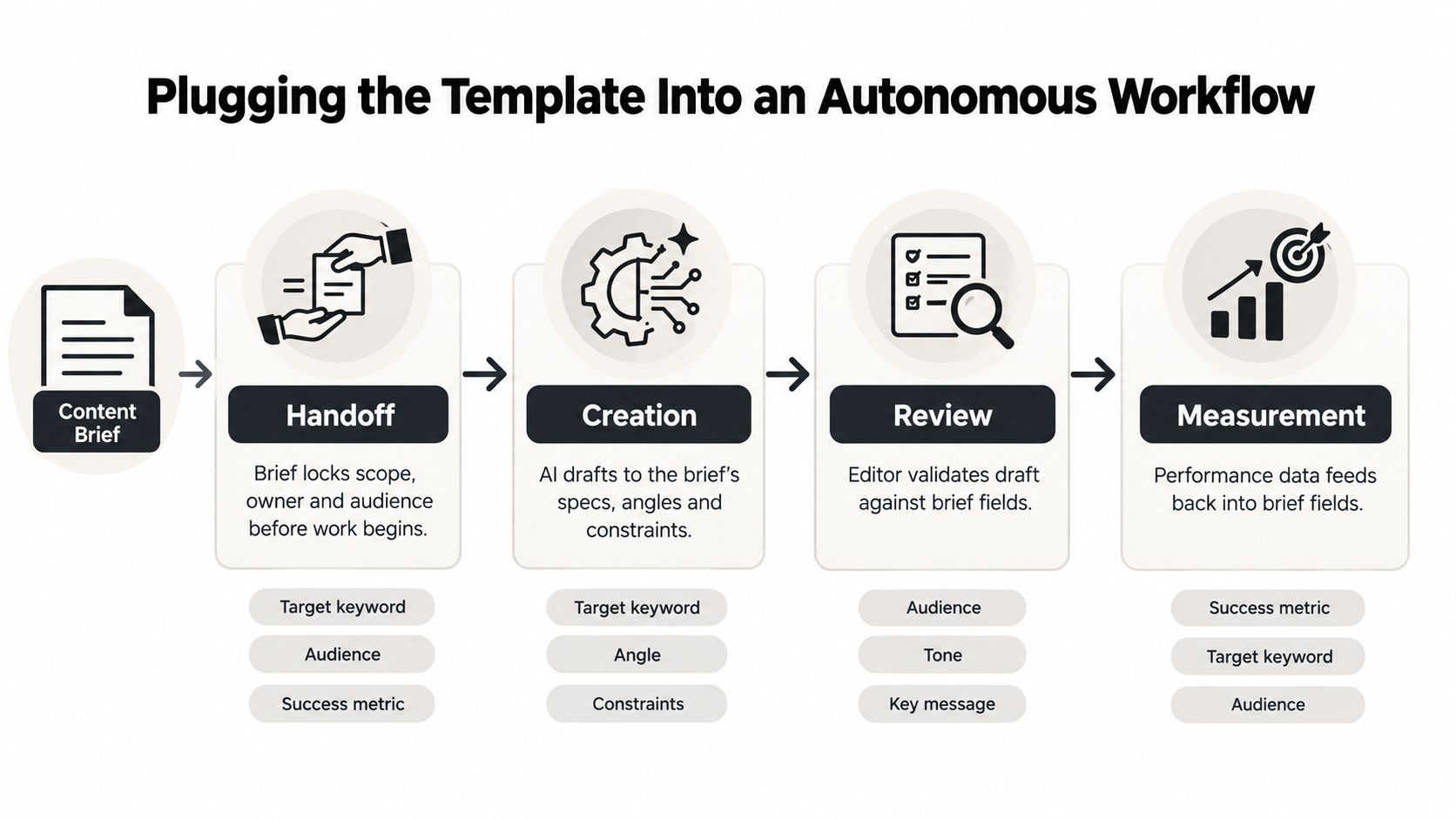
The brief becomes valuable when it travels with the work instead of disappearing into a planning folder. Each workflow phase should read a different subset of fields and return evidence to the same record.
Handoff
The producer receives the customer segment, lifecycle stage, reader outcome, primary angle, brand voice, destination channel, deadline, owner, and approval level. A strategist shouldn't need a second meeting to explain whether the asset targets acquisition or retention.
The handoff gate is binary. If the audience, objective, CTA, or owner is unresolved, the brief returns for clarification before creation. Teams exploring AI-assisted production can also explore content generation use cases to identify which transformations are suitable for structured automation.
Creation
The producer uses the query, intent, outline, sources, links, evidence rules, and risk classification. AI can draft within those boundaries, but it shouldn't invent the angle or select a business metric after the fact.
Review
The editor validates the draft against the brief fields, not personal preference. The acceptance record should state whether the reader outcome is met, claims are evidenced, links are correct, the CTA matches the stage, accessibility checks pass, and the defined approver has signed off. A documented content approval workflow helps keep those decisions visible.
Approval should answer “which condition passed,” not merely “does this look good?”
Measurement
After publication, the baseline, comparison group, success metric, data source, owner, and review date control the verdict. The result should feed back into the brief so the next version reflects what the team learned.
The AI CMO can operate this model as one option for teams that want briefs connected to content creation, sending, customer data, approval levels, holdout groups, and an append-only record of decisions. The important design choice is the connection, not the particular platform.
A minimum acceptance card can sit beside every brief:
- Scope: The asset matches the declared audience, format, and intent.
- Evidence: Required claims have approved sources and named reviewers.
- Brand: Voice, accessibility, and channel requirements pass.
- Permission: The recorded trust level allows the requested publication action.
- Measurement: Baseline, owner, comparison, and review date are present.
Habits That Keep the Template Alive After Week One
Templates decay when teams treat them as forms instead of operating instruments. The durable habit is to review which fields caused re-briefs, remove fields nobody reads, gate every shipped asset through its measurement fields, and revisit AI controls when policies, platforms, or risk levels change.
A practical owner can take five actions this week:
- Copy the template: Put the eleven fields above into the team's working system.
- Fill one real example: Use an upcoming article, email, or landing page.
- Attach it to production: Make the brief the source of truth at handoff.
- Set the review date: Put measurement on the calendar before publication.
- Assign the metric owner: Name the person responsible for the verdict.
Distributed teams may also use specialist support, including the best place to hire Latin American virtual assistants, when administration threatens to displace strategic work. The governing test remains direct: if a human or AI producer can't execute the document without follow-up questions, it isn't a brief. It's a wish list.
The AI CMO connects structured briefs with AI specialists, Studios, first-party customer data, approval controls, journeys, holdouts, and measurement in one marketing operating system. Build the next brief around a real acquisition or retention decision, then visit The AI CMO to see how the workflow can move from strategy to governed execution and proof.
Share this article